
Nickel: The Critical Metal Powering Industry, and Why Scrap Is Now Strategic
Nickel scrap is no longer just a secondary supply source. As global production becomes more concentrated, recycled nickel is playing a critical role in ensuring reliable access for industries that cannot afford compromise.
A foundational metal hiding in plain sight
Nickel rarely commands attention, yet it underpins some of the most essential sectors of the global economy. It is not a consumer-facing material, nor is it often discussed outside industrial circles. Still, its role is both pervasive and critical.
From structural steel to high-performance alloys, nickel enables durability, corrosion resistance, and strength in environments where failure is simply not an option. While recent narratives have centred on battery technology and electric vehicles, the broader demand landscape tells a more grounded story. Nickel is not just a future-facing material, it is a present-day necessity.
Where nickel demand is really anchored
A closer look at global consumption patterns reveals that nickel’s importance extends far beyond emerging technologies. Its primary demand drivers are deeply embedded in industries that support infrastructure, energy, and advanced manufacturing.
Stainless steel remains the dominant force
Approximately 65 to 70 percent of global nickel demand is tied to stainless steel production. This alone positions nickel as a cornerstone of industrial development.
Stainless steel is integral to construction, transportation systems, food processing facilities, and medical equipment. Its corrosion resistance and mechanical strength make it indispensable across both developed and developing economies. Without nickel, the performance characteristics of stainless steel would be significantly compromised.
Oil and gas depend on nickel alloys
In the energy sector, particularly oil and gas, nickel alloys play a critical role in ensuring operational reliability. Offshore platforms, subsea infrastructure, and liquefied natural gas facilities all operate in highly corrosive and high-pressure environments.
Nickel-based materials are often the only viable option for maintaining structural integrity under these conditions. As global energy demand persists and projects move into increasingly challenging environments, the reliance on nickel alloys remains firm.
Aerospace requires absolute material performance
The aerospace sector presents one of the most demanding use cases for nickel. Jet engines operate at extreme temperatures where most metals would fail. Nickel-based superalloys provide the necessary heat resistance and strength required for safe and efficient performance.
There are no scalable substitutes that offer the same combination of properties. This makes nickel a non-negotiable component in aviation and related industries.
Battery demand is growing, but still secondary
The rise of electric vehicles has introduced a new layer of demand for nickel, particularly in battery chemistries designed to improve energy density. While this segment is expanding, it still represents a smaller share of total consumption compared to stainless steel and heavy industry.
Battery demand is important, but it does not yet define the nickel market. The structural demand from established industries continues to dominate.
A supply chain shaped by concentration and control
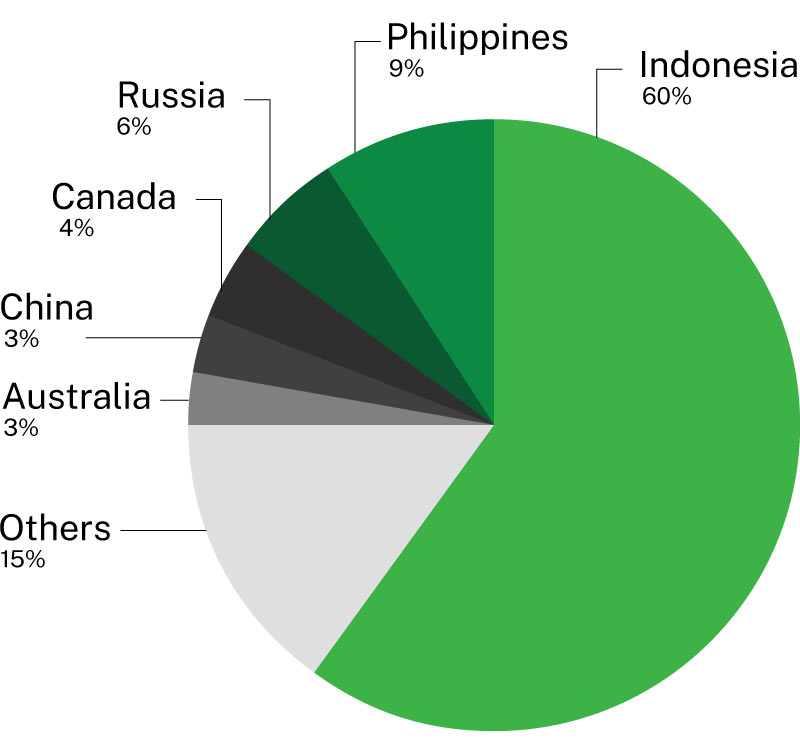
Nickel supply is not constrained by availability in the earth’s crust. Instead, it is shaped by geographic concentration and evolving geopolitical strategies.
Indonesia currently accounts for approximately 60 percent of global nickel production. When combined with other leading producers, the top three countries control more than 70 percent of supply. This level of concentration introduces a degree of vulnerability into the global supply chain.
In addition, producing countries are increasingly implementing policies aimed at capturing more value domestically. Export restrictions, processing mandates, and downstream investment requirements are becoming more common.
These developments are not simply regulatory adjustments. They are fundamentally reshaping how nickel moves through global markets.
Scrap nickel is no longer secondary
Against this backdrop, scrap nickel and recycled alloys are taking on a more central role in supply strategies. What was once considered supplementary is now being treated as a reliable and, in many cases, essential source of material.
Immediate availability supports operational continuity
Unlike primary production, which involves long lead times associated with mining and refining, scrap material is already in circulation. It exists within manufacturing waste streams, decommissioned equipment, and industrial processes.
This immediate availability allows businesses to respond more quickly to demand without being exposed to the delays inherent in new mining projects.
Lower energy requirements improve efficiency
Recycling nickel requires significantly less energy than extracting and processing it from ore. This not only reduces operational costs but also aligns with increasing pressure to improve environmental performance across supply chains.
High-spec industries rely on recycled material
In sectors such as aerospace and specialised manufacturing, material integrity is critical. Recycled nickel retains its metallurgical properties, making it suitable for high-performance applications.
In many cases, recycled material is already integrated into production processes without compromising quality or performance.
Full value retention strengthens its economic role
Nickel does not degrade through recycling in the way some materials do. Its core properties remain intact, allowing it to be reused repeatedly without loss of function.
This characteristic enhances its value within circular supply models and reinforces its role as a strategic resource.
The shift from extraction to access
The conversation around nickel is changing. Historically, the focus has been on exploration, extraction, and production capacity. While these factors remain important, they are no longer sufficient on their own.
Access, consistency, and reliability have become equally important considerations.
As supply becomes more concentrated and policy-driven, businesses are placing greater emphasis on securing dependable sources of material. Scrap nickel, with its availability and performance characteristics, is increasingly central to this approach.
A strategic resource in a changing market
Nickel’s role in the global economy is both stable and evolving. Its importance to core industries ensures consistent demand, while shifts in supply dynamics are redefining how that demand is met.
Scrap is no longer a secondary consideration. It is a strategic component of the supply chain, offering immediacy, efficiency, and reliability in an increasingly complex market.
For businesses operating in sectors where material performance cannot be compromised, access to high-quality nickel, whether primary or recycled, is becoming a defining factor in maintaining competitiveness and continuity.
Nickel is not scarce — reliable supply is.
Operators who secure scrap flows, understand alloy chemistry, and build direct supply relationships will outperform those trading blindly on price